Guddhameva Jayate!
TEOTONIO R DE SOUZA laments the fact that Goans who try to be critically creative get little support and encouragement
T aking stock of the year ending – one more of the many that have ended and others that will follow and end – are we not more inclined than ever to be driven down the path of a Labadda Upanishad rather than to be elevated by the Mundaka Upanishad? In other words, the preferred motto of the national citizens today seems to be ‘Guddhamella Jayate’! In Bardeshi lingo guddhamella would be pronounced as guddhameva – that rhymes well with the ‘Satyameva’ of the Indian national motto. Dalgado’s Konkani-Portuguese dictionary provides the meaning of guddhamella as pacto secreto, conluio (secret pact, conspiracy). Instead of the Upanishadic world of mumukshu, we now live in the brave new world of aparavidya where truth is stranger than fiction. While truth forces one to look at the reality outside confronting us, fiction promises autonomy and egoistic uni-directionality of Kafkaian einsinnigkeit, one-track mindedness of the maniacs. Dedicated terrorists are just one of the frightening results of this trend, but we have a whole range of other variants, beginning with the milder variety of fiction writers who pick up their knowledge of history from book cover flaps. We have such mushrooming literati in Goa-related internet forums and some local press organs that cater to peasant tastes. This lot is condemned to producing fait divers that will hardly be remembered after a year ends. To prevent that from happening to him, one such guddhameva-lover resorted to Goanet before the year ended to remind us of what he wrote on Herald in 1996. It was about a controversy he invented, but saw the need of recruiting Shirodkars, Pearson and Teotonio to corner some public attention to his ability. He also denounces his own democratic credentials, seeking to protect the unwary masses from the foreign influences he attributed to the above-mentioned authors: “Too many common people have begun subscribing to such views and they should be stopped before the situation deteriorates.” Is that also a reflection of “foreign concepts like Marxism, or other strange ideas like Feminism or Post-Structuralism and so forth”, or is it Derrida’s “democracy to come”?It is a pity so much talent and energy in Goa are wasted on trifles and petty issues, instead of supporting and encouraging those who try to be critically creative. We do not object to destroying to construct, and isn’t that the symbolic message of the cosmic dance of Nataraja? Goans crying wolf about their identity in danger could try to be more attentive and concerned about the attempts being made to “invent” Goa to cater for market-oriented academic and non-academic tastes. One need not fall into the easy trap of calling it post-colonialism or fail to accept critically any positive contributions coming from any source. Before I present a few recent attempts at understanding Goa and Goans better, including one high-falutin bombastic “invention”, I cannot but denounce painfully the cases of promising Goan/Indian scholars who manifest their insecurity by preferring at times to pay homage to questionable Western scholarship to proven and better substantiated native research. This inheritance of orientalism is unfortunately still with our young generations, and it bodes ill for the immediate future. Correspondingly, the young generations in the West are still suffering from the occidentosis of their forefathers, and still reveal the hangover of a colonial superiority complex. These young generations in the West include some of Goan/Indian origin. During the past two decades nearly a dozen young and not-so-young Goans have made noteworthy contributions to the understanding of different aspects of Goa’s cultural past. Without intending to keep anyone out, I remember P P Shirodkar, S K Mhamai, Charles Borges, Pratima Kamat, Shyam Bhat, P D Xavier, Celsa Pinto, Fatima Gracias, Philomena Antony, Délio Mendonça, Phal Desai, Xavier Martins, Sharon D’Cruz, Remy Dias and Rochelle Pinto, who have produced PhD theses on themes related to Goa. I had the honour of guiding the research of at least three of them officially. Maria Aurora Couto is a specialist in English literature, but has given us a masterpiece of cultural studies in the form of the autobiographical Goa: A Daughter’s Story. Lourdes Bravo da Costa Rodrigues is no less active in tracing Goa’s cultural traditions. And we have more such worthy examples. One does not necessarily need a University diploma to make a mark. Most of these researchers have consulted and utilised information produced by Filipe Nery Xavier and a host of others who never saw any University. For further proof one need only to glance through the three volumes of Dicionário de Literatura Goesa recently compiled by Aleixo Manuel da Costa. How many readers of this column have made an effort to find out what exactly each of the above mentioned scholars produced to enrich our knowledge about Goa? That could be a test of sincerity and honesty of Goans who proclaim their concern for Goa’s identity and future. I could list another dozen of foreign scholars who have worked on Goa and we owe them gratitude for that. Some of them are very senior or senior scholars, like M N Pearson, G D Winius, A Disney, Robert Newman, Caroline Ifeka, Janet Rubinoff, A T Matos, M J Mártires Lopes, Cristiana Bastos, Timothy Coates, Tim Walker, Susana Sardo, Paul Axelrod, Michelle Fuerch and R Trichur, who have covered such varied aspects as history, anthropology, ethnomusicology and tourism studies. As one can expect, Portugal will continue to take interest in the field, and more recently we have seen published research by two young and upcoming scholars, Catarina Madeira Santos and Angela Barreto Xavier. We may have other occasions to appreciate the specific contributions of these various scholars, both Goan and foreigners, but for now let us have only a very brief review of Angela Barreto Xavier’s A Invenção de Goa (Lisboa, ICS, 2008). This scholar shares the virtues and defects of a young scholar. With a PhD from the European Institute of Florence, and with a glamorous institutional affiliation in Portugal, this Portuguese citizen of Goan origin could be more modest in her work and not just in words. She seems to have discovered the moon, and classifies summarily and brattishly most existing studies as “synchronic”, “orientalist”, “nationalistic”, etc. She offers us a diachronic approach to prove that the Portuguese imperial presence in Goa was made possible by consent and negotiation between all parties, and not necessarily by any hegemonic group, imperial or local. Curiously, she contradicts her own premises, choosing to cite a Goan priest, A Frias, and using him as a metaphor and point of departure for her research. In addition to inventing a Jesuit General Jacopo Lainez (p 140), the Hindus of Sirula may learn about their ‘Garam-Purusha’ (p 186). The author rushes into details wherein the angels would fear to tread: while dealing with the caste traditions of Chorão (pp 277 ff), instead of quoting Srinivasan and Cohn, a much better job could be done by consulting and citing F X Gomes Catão who published his extensive ‘Notes for the History of Chorão’ in the Portuguese journal Studia (nos 15 & 17, 1965-66). The title of this thesis well justifies the contents and approach of the book. More modesty and less brashness augur a better future for any research.
Satyameva Jayate!
Saturday, January 3, 2009


Tiatr-ical theory
Tiatr-ical theory
Sayeesh Naik, Marcel
How often have we seen the ‘Ayurvedic’ peddler of patent medicine, who sits at the roadside with bowls full of herbs, narrating to bystanders how his magic concoction can cure every illness, from arrhythmia to arthritis and from indigestion to impotence? Now, similarly, we have a ‘single solution’ to each and every one of Goa’s ills. According to Wilson ‘Wilmix’ Mazarello, the root cause of all of Goa’s chronic problems (which he says are mere symptoms) is Konkani; because it has been chained by the present Official Language Act (‘Official Language Act: The cause of all our problems’, OPinionatED, Herald, 1 Jan). If only that perfidious Act is totally removed and we ‘set Konkani free’, Wilmix implies, Goans will stop mistrusting each other, the mega-project standoff in villages will come to an end, the SEZ controversy will be over, members of Utt Goykara and the Goa Bachao Abhiyan (GBA) will stop infighting and playing the blame game, and people’s suspicion and hatred for the regional plans will disappear. Wonderful, is it not, that one single deed could make everyone happy? A perfect ending – for a tiatr. Life, unfortunately, is far more complicated. If the Official Language Act is removed, Konkani will no longer be Goa’s official language! Wilmix is a great tiatrist. But he should stick to his strengths. Goans have fought long and hard for Konkani and statehood. They cannot even think of gambling it away on the basis of a whimsical, tiatr-ical theory.
(As published in the Herald / 3 Jan 2009)
Sayeesh Naik, Marcel
How often have we seen the ‘Ayurvedic’ peddler of patent medicine, who sits at the roadside with bowls full of herbs, narrating to bystanders how his magic concoction can cure every illness, from arrhythmia to arthritis and from indigestion to impotence? Now, similarly, we have a ‘single solution’ to each and every one of Goa’s ills. According to Wilson ‘Wilmix’ Mazarello, the root cause of all of Goa’s chronic problems (which he says are mere symptoms) is Konkani; because it has been chained by the present Official Language Act (‘Official Language Act: The cause of all our problems’, OPinionatED, Herald, 1 Jan). If only that perfidious Act is totally removed and we ‘set Konkani free’, Wilmix implies, Goans will stop mistrusting each other, the mega-project standoff in villages will come to an end, the SEZ controversy will be over, members of Utt Goykara and the Goa Bachao Abhiyan (GBA) will stop infighting and playing the blame game, and people’s suspicion and hatred for the regional plans will disappear. Wonderful, is it not, that one single deed could make everyone happy? A perfect ending – for a tiatr. Life, unfortunately, is far more complicated. If the Official Language Act is removed, Konkani will no longer be Goa’s official language! Wilmix is a great tiatrist. But he should stick to his strengths. Goans have fought long and hard for Konkani and statehood. They cannot even think of gambling it away on the basis of a whimsical, tiatr-ical theory.
(As published in the Herald / 3 Jan 2009)
Suppression of Romi Konkani
Suppression of Romi Konkani
Fri Jan 2 2009
ToThe Editor,Herald, Panjim Goa.
SUB:Injustice for Konkani people by Herald or is it by few staff reporters?
Sir,I am one of the regular reader/subscriber for the Herald (since 1983) and it gives me great pleasure to bring to the notice of the editor or their staff of any injustice is felt by its readers. I consider myself Herald is the only newspaper that represents to the poorest of the poor and people seeking justice irrespective of cast, creed and language. Nobody can dispute your efforts for making Konkani as the mother tongue of Goa. As a true lover and activist of Konkani then and now, I can proudly nullify the claim from any quarter and pull the string towards Herald. The battle was initiated by KPA but Herald was leading from the front with lakhs of Romi Konkani jawans suffering bullets lathis, hartals hundreds of them physically handicapped for life and 7 of them losing their lives forever. To mention another incident, your work during the CHOGM Retreat especially the front pages Photos and headlines had driven out the rest of the Goan Newspapers from the CHOGM Media Centre at Fidalgo where hundreds of print and media people were flashing out their news around the globe. I was personally involved in promoting our own Herald with no personal benefits whatsoever with the addition of my company's work allotted to me in the Media Centre. To be frank I was awarded a Special Certificate by the Director,In charge & Public Relation Officer, Media Centre (PIB) New - Delhi Mr.Suresh Chopra which I am still holding as an asset.My point to write you few lines on the subject that very recently it is noticed that Herald or its few reporters are giving step motherly treatment for the Romi Konkani lovers which is hard to believe. As a president of the Konkani organization registered with the govt.of Goa I had attended the two day "Poilem Konknni (Romi Lipi) Sahitya ani Sonsvkruti sommelon at Ravindra Bhavan,Pai Tiatrist Joao Agostinho Fernandes Nagar, Margao Goa .It was organized in a most dignified and fantastic way.The two day literary and cultural seminarhad opened the eyes of many except the few Devnagari Terrorists. I find no reason to believe whatever Fr.Pratap Naik and Churchill Alemao had spoken about the sufferings of Konkani and its people.Shri Alemao and Fr.Pratap deserves all the compliments and supports as had come out with facts and figures.Fr.Pratap is running an institution and made several discoveries that exposes the lies of the Devnagiri fanatics as their work in the last 22 years have failed to match the work of the literary priest. In Konkani we have the old saying"Chorak khuim tondd vodlem" Naiqinik khuim Naiquinn mhonnlear rag eta"Ajeak xikoitalo natu'(Someone younger or immature advising an older and wiser person. The Konknni Bhaxa Mondol and Asmitai Pratisthan have no right to criticize the priest as they have failed miserably to develop the Konkani language and on the contrary indirectly always supported the cause of Marathi. The people who had lost lives, money, faced lathis and bullets were systematically put into great inconvenience by these same Devnagiri terrorists,like any atkankwadi they have crushed the minorities for the last 22 years. Now to blame the Congress leaders for drafting the Official Language Bill is the easy way to pass the buck.Now as far as Herald is concern kindly check the news publicity given to Press report of Konkani Bhaxa Mandal and Ashmitai Prathistan in the last few days (both Devnagiri Associations) and the publicity given to Romi Lipi Sommelon or other Romi Konknni associations. Please judge it your self or may be someone is working silently to crush the movement of the Romi Konkani without the knowledge of Herald in Herald. I am not ready to believe such thingsscan happen in 'VOICE OF GOA'Please consider this as an advice.Thanks.
Fri Jan 2 2009
ToThe Editor,Herald, Panjim Goa.
SUB:Injustice for Konkani people by Herald or is it by few staff reporters?
Sir,I am one of the regular reader/subscriber for the Herald (since 1983) and it gives me great pleasure to bring to the notice of the editor or their staff of any injustice is felt by its readers. I consider myself Herald is the only newspaper that represents to the poorest of the poor and people seeking justice irrespective of cast, creed and language. Nobody can dispute your efforts for making Konkani as the mother tongue of Goa. As a true lover and activist of Konkani then and now, I can proudly nullify the claim from any quarter and pull the string towards Herald. The battle was initiated by KPA but Herald was leading from the front with lakhs of Romi Konkani jawans suffering bullets lathis, hartals hundreds of them physically handicapped for life and 7 of them losing their lives forever. To mention another incident, your work during the CHOGM Retreat especially the front pages Photos and headlines had driven out the rest of the Goan Newspapers from the CHOGM Media Centre at Fidalgo where hundreds of print and media people were flashing out their news around the globe. I was personally involved in promoting our own Herald with no personal benefits whatsoever with the addition of my company's work allotted to me in the Media Centre. To be frank I was awarded a Special Certificate by the Director,In charge & Public Relation Officer, Media Centre (PIB) New - Delhi Mr.Suresh Chopra which I am still holding as an asset.My point to write you few lines on the subject that very recently it is noticed that Herald or its few reporters are giving step motherly treatment for the Romi Konkani lovers which is hard to believe. As a president of the Konkani organization registered with the govt.of Goa I had attended the two day "Poilem Konknni (Romi Lipi) Sahitya ani Sonsvkruti sommelon at Ravindra Bhavan,Pai Tiatrist Joao Agostinho Fernandes Nagar, Margao Goa .It was organized in a most dignified and fantastic way.The two day literary and cultural seminarhad opened the eyes of many except the few Devnagari Terrorists. I find no reason to believe whatever Fr.Pratap Naik and Churchill Alemao had spoken about the sufferings of Konkani and its people.Shri Alemao and Fr.Pratap deserves all the compliments and supports as had come out with facts and figures.Fr.Pratap is running an institution and made several discoveries that exposes the lies of the Devnagiri fanatics as their work in the last 22 years have failed to match the work of the literary priest. In Konkani we have the old saying"Chorak khuim tondd vodlem" Naiqinik khuim Naiquinn mhonnlear rag eta"Ajeak xikoitalo natu'(Someone younger or immature advising an older and wiser person. The Konknni Bhaxa Mondol and Asmitai Pratisthan have no right to criticize the priest as they have failed miserably to develop the Konkani language and on the contrary indirectly always supported the cause of Marathi. The people who had lost lives, money, faced lathis and bullets were systematically put into great inconvenience by these same Devnagiri terrorists,like any atkankwadi they have crushed the minorities for the last 22 years. Now to blame the Congress leaders for drafting the Official Language Bill is the easy way to pass the buck.Now as far as Herald is concern kindly check the news publicity given to Press report of Konkani Bhaxa Mandal and Ashmitai Prathistan in the last few days (both Devnagiri Associations) and the publicity given to Romi Lipi Sommelon or other Romi Konknni associations. Please judge it your self or may be someone is working silently to crush the movement of the Romi Konkani without the knowledge of Herald in Herald. I am not ready to believe such thingsscan happen in 'VOICE OF GOA'Please consider this as an advice.Thanks.
Tuesday, December 30, 2008
Dominic Carvalho - In love with the stage from a young age
In love with the stage from a young age
by J P PEREIRA
Posted on 2008-12-01/The Navhind Times
Dominic Carvalho, actor and playwright, hails from Calata, Majorda. He is the son of the late Jose Maria Carvalho and Josefa. The late Jose was a stage actor and known for the lyrics he would compose, in those days. Dominic took interest in the konkani stage from a very young age.
During schooling at St Aloysius High School, Majorda, where he completed SSC, the young boy was a regular in the songs and plays, for the school gathering. At the age of 9, his uncle, Agnelo Carvalho introduced him on the konkani stage in the tiatr titled "Dhavem Bott", where he did a comedy role and rendered solos. Later he acted opposite Querobina, well known comedian, in Inacio Carvalho's drama.
The budding actor, then continued at the amateur level with directors like Pascoal Rodrigues (an established writer/director today), Agnelo Ferrao, Saby Ferns, the late Effie de Nuvem, Ronnie Severes and others. Dominic then began producing his own shows on the amateur stage. Beginning with �Favo Zalo Maka� he continued with �Sot�, �Vattsuro� (which was also staged at Utorda) and some others.
In 1989, Dominic was appointed as a plant operator by the Sports Authority of Goa and then, left for the Saudi Arabia where he worked for 7 years. On return, Dominic was back to his first love. He began with "Tuzo Sangati Xonn?". The show was staged for a charitable cause, at Majorda, with professionals like M Boyer and Mini Mario. Comedian Michael encouraged the new director to present the show commercially.
This was done under the banner of J M Productions, (in memory of Dominic�s late father Jose Maria) and devoted to Our Lady of Valankanni. The play completed 25 shows. This was followed by "Tem Ek Sopon", "Tumkam Kitem Dium", "To Lipcho Na" and "Ti Tuka Rauta". The latest release is "Tim Odhik Bhagi", presented with a good cast that also includes, Marcos Vaz.
The show has been released and at Mapusa, a viewer awarded Dominic cash prize worth
Rs. 5000/- for the quality of the story and its moral.
He has also taken part in radio plays by J M Pereira and Saby Femandes, on the All India Radio. Many new artistes introduced by Dominic, are on the professional stage today. He advises newcomers to come forward, and show their talent, so that they can be introduced on the stage. He is thankful to the audience, for their support and also to his family, who help him in every way. At present, he is General Secretary of the St Rock's Youth Club, Calata and is a self employed electrician.
We wish you all the best Dominic, Keep on writing and presenting good plays.
by J P PEREIRA
Posted on 2008-12-01/The Navhind Times
Dominic Carvalho, actor and playwright, hails from Calata, Majorda. He is the son of the late Jose Maria Carvalho and Josefa. The late Jose was a stage actor and known for the lyrics he would compose, in those days. Dominic took interest in the konkani stage from a very young age.
During schooling at St Aloysius High School, Majorda, where he completed SSC, the young boy was a regular in the songs and plays, for the school gathering. At the age of 9, his uncle, Agnelo Carvalho introduced him on the konkani stage in the tiatr titled "Dhavem Bott", where he did a comedy role and rendered solos. Later he acted opposite Querobina, well known comedian, in Inacio Carvalho's drama.
The budding actor, then continued at the amateur level with directors like Pascoal Rodrigues (an established writer/director today), Agnelo Ferrao, Saby Ferns, the late Effie de Nuvem, Ronnie Severes and others. Dominic then began producing his own shows on the amateur stage. Beginning with �Favo Zalo Maka� he continued with �Sot�, �Vattsuro� (which was also staged at Utorda) and some others.
In 1989, Dominic was appointed as a plant operator by the Sports Authority of Goa and then, left for the Saudi Arabia where he worked for 7 years. On return, Dominic was back to his first love. He began with "Tuzo Sangati Xonn?". The show was staged for a charitable cause, at Majorda, with professionals like M Boyer and Mini Mario. Comedian Michael encouraged the new director to present the show commercially.
This was done under the banner of J M Productions, (in memory of Dominic�s late father Jose Maria) and devoted to Our Lady of Valankanni. The play completed 25 shows. This was followed by "Tem Ek Sopon", "Tumkam Kitem Dium", "To Lipcho Na" and "Ti Tuka Rauta". The latest release is "Tim Odhik Bhagi", presented with a good cast that also includes, Marcos Vaz.
The show has been released and at Mapusa, a viewer awarded Dominic cash prize worth
Rs. 5000/- for the quality of the story and its moral.
He has also taken part in radio plays by J M Pereira and Saby Femandes, on the All India Radio. Many new artistes introduced by Dominic, are on the professional stage today. He advises newcomers to come forward, and show their talent, so that they can be introduced on the stage. He is thankful to the audience, for their support and also to his family, who help him in every way. At present, he is General Secretary of the St Rock's Youth Club, Calata and is a self employed electrician.
We wish you all the best Dominic, Keep on writing and presenting good plays.
Konkani Utsav
Konkani Utsav
Konkani Utsav will be held on December 8, 2008 at St Lawrence Church.
As part ofthe utsav, there will be procession, mass, felicitation and cultural
programmes.
Konkani Utsav will be held on December 8, 2008 at St Lawrence Church.
As part ofthe utsav, there will be procession, mass, felicitation and cultural
programmes.
Convention on Konkani Literature & Culture - Dec. 20/21, 2008
Convention on Konkani literature
12 Dec 2008, 0545 hrs IST, TNN
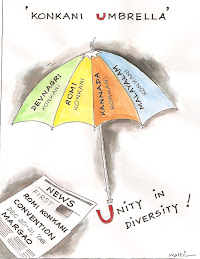
PANAJI: Dalgado Konknni Akademi (DKA), an organization working for the promotion and development of Konkani in the Roman script, will be organizing the first ever Konkani (Roman script) literature and culture convention on December 20 and 21 at Ravindra Bhavan, Margao. Chief minister Digambar Kamat will inaugurate the two-day convention on December 20 at 4.30 pm in the presence of deputy speaker Mauvin Godinho. Eminent personalities from the field of literature and culture will be felicitated on the occasion. PWD minister Churchill Alemao will be the chief guest for the concluding ceremony. The concluding ceremony will be followed by a tiatr Tandallachem Kestanv' written by Pai tiatrist Joao Agostinho Fernandes and directed by Anil Kumar. Addressing a press conference on Thursday, working president of the event, Vincy Quadros, said that the convention aims at enhancing the prospects of Konkani literature and culture by offering an opportunity to all those involved in these fields to interact with their fellowmen. "For decades, Roman script Konkani has been struggling to get its due recognition. The urge to congregate under a single umbrella on a common platform and discuss and explore ways and means to develop and strengthen the Roman script is being felt like never before," Quadros said.
12 Dec 2008, 0545 hrs IST, TNN
PANAJI: Dalgado Konknni Akademi (DKA), an organization working for the promotion and development of Konkani in the Roman script, will be organizing the first ever Konkani (Roman script) literature and culture convention on December 20 and 21 at Ravindra Bhavan, Margao. Chief minister Digambar Kamat will inaugurate the two-day convention on December 20 at 4.30 pm in the presence of deputy speaker Mauvin Godinho. Eminent personalities from the field of literature and culture will be felicitated on the occasion. PWD minister Churchill Alemao will be the chief guest for the concluding ceremony. The concluding ceremony will be followed by a tiatr Tandallachem Kestanv' written by Pai tiatrist Joao Agostinho Fernandes and directed by Anil Kumar. Addressing a press conference on Thursday, working president of the event, Vincy Quadros, said that the convention aims at enhancing the prospects of Konkani literature and culture by offering an opportunity to all those involved in these fields to interact with their fellowmen. "For decades, Roman script Konkani has been struggling to get its due recognition. The urge to congregate under a single umbrella on a common platform and discuss and explore ways and means to develop and strengthen the Roman script is being felt like never before," Quadros said.
Tiatr Festival organized by The Parish Youth of Santa Cruz
Tiatr fest held at Santa Cruz
PANJIM(HND):
The Parish Youth of Santa Cruz organized a three day Tiatr Festival recently in the Santa Cruz Higher Secondary School premises. Tiatr‘'Hanv Porot Ietelim'’ directed by Succoro De Santa Cruz was staged on the inaugural day.
The second day saw a considerably good response from thecrowd providing them good entertainment from ‘"Sogllim Sopnam GupitChintanam"’ by comedian Domnic.
On the final day, the Tiatr ‘"Mhaka Zobab Zai"’ directed by Rose Ferns drew ahuge crowd.
Parish Priest of Santa Cruz Fr Saud Pereira along with Fr Kenneth Teles, FrCamilo Dias and Fr Noel graced the occasion.
12/12/2008
PANJIM(HND):
The Parish Youth of Santa Cruz organized a three day Tiatr Festival recently in the Santa Cruz Higher Secondary School premises. Tiatr‘'Hanv Porot Ietelim'’ directed by Succoro De Santa Cruz was staged on the inaugural day.
The second day saw a considerably good response from thecrowd providing them good entertainment from ‘"Sogllim Sopnam GupitChintanam"’ by comedian Domnic.
On the final day, the Tiatr ‘"Mhaka Zobab Zai"’ directed by Rose Ferns drew ahuge crowd.
Parish Priest of Santa Cruz Fr Saud Pereira along with Fr Kenneth Teles, FrCamilo Dias and Fr Noel graced the occasion.
12/12/2008
Subscribe to:
Posts (Atom)